Balance: It’s Essential — Here Are Pro Tips to Help You Maintain It
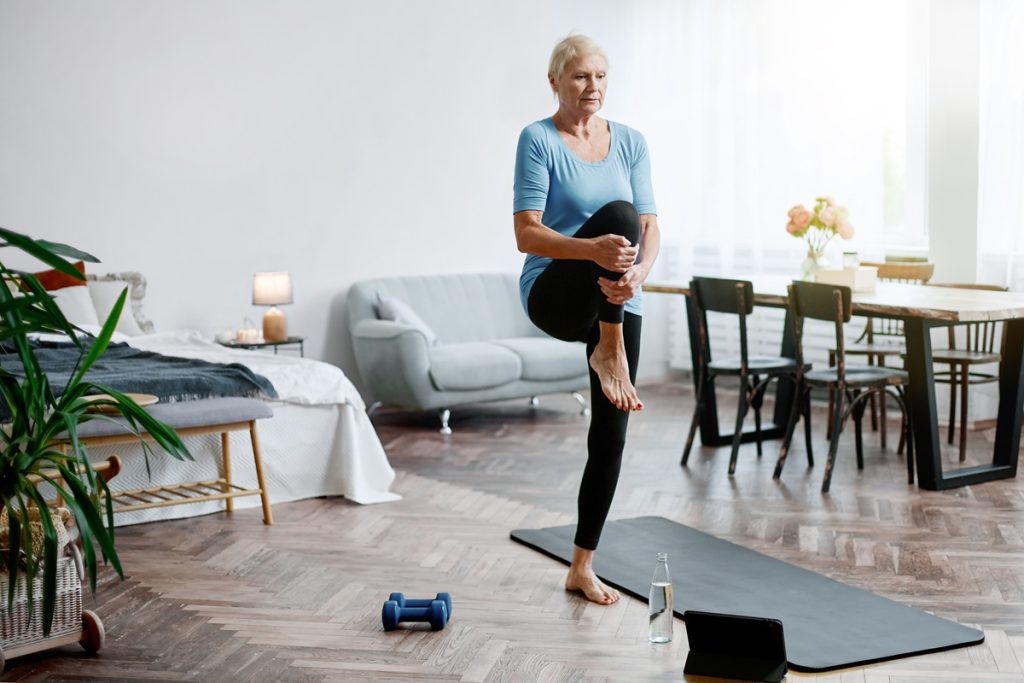
Can you easily stand on one leg? That’s good news! According to a recent study from the Mayo Clinic, this simple ability may be a good indicator of healthy aging. But why is balance so important? And more importantly, how can you improve it?
Balance is essential for maintaining an active lifestyle, says Isabelle Dionne, researcher at the Research Chair in Healthy Aging and professor at the Université de Sherbrooke.
“It allows us to carry out many daily activities with ease and efficiency, such as moving around, climbing stairs, or carrying loads like grocery bags. And it’s crucial for mobility,” she explains.
Balance is also linked to proprioception—the ability to sense your body in space and adjust to changes, like when you step on a rock. It’s one of the factors that help prevent falls, though not the only one, adds the specialist.
“If you step into a hole, you’ll lose your balance. You need to be quick and strong enough to regain your footing.”
Build Your Balance
The good news is that balance can be improved at any age.
“The best way to get better is to practise activities that create a bit of imbalance and force us to regain stability,” says Isabelle Dionne.
For example, instead of walking on a smooth sidewalk, you could choose a forest trail with rocks and roots, or take a path with an incline.
Activities like yoga, Pilates, or dance (line dancing, partner dancing, or solo) also help improve stability. Isabelle Dionne also recommends practising tai chi. This Chinese martial art is especially beneficial for older adults and for people with Parkinson’s disease who need to strengthen their balance.
“The movements are slow, and the postures are demanding for balance. Holding them helps build muscle strength.”
Just Move More
More broadly, any regular physical activity helps improve balance. The ability to stay on your feet also depends on muscle strength, power, and the speed at which you can perform movements. “Because if I step forward to regain my balance but I’m not strong enough to support my body weight, I’ll simply collapse. Same thing if I’m not quick enough to catch myself.” Staying active is therefore a great way to maintain these abilities.
Some people prefer doing exercises at home—like standing while holding onto a chair or practising basic balance movements. However, for those who want to train at home, some precautions are needed.
“Poorly executed exercises or an environment that isn’t safe can create more risks than benefits,” reminds Isabelle Dionne.
People who already struggle with balance or who aren’t very fit would benefit from seeking advice from a kinesiologist or following an adapted program.
Several programs have been developed specifically for older adults, including MOVE – En équilibre, a project co‑developed by Isabelle Dionne for people aged 65 and over. The program includes twelve exercise sessions designed to improve balance, all available online for free.
In short, whether it’s a walk outdoors, a tai chi class, or home exercises, every opportunity is a good one to work on your balance. It’s an effort that pays off, since balance is a key ingredient for staying independent as long as possible!
Discover the MOVE – In Balance Program
Source: Anne-Marie Tremblay - Magazine Virage